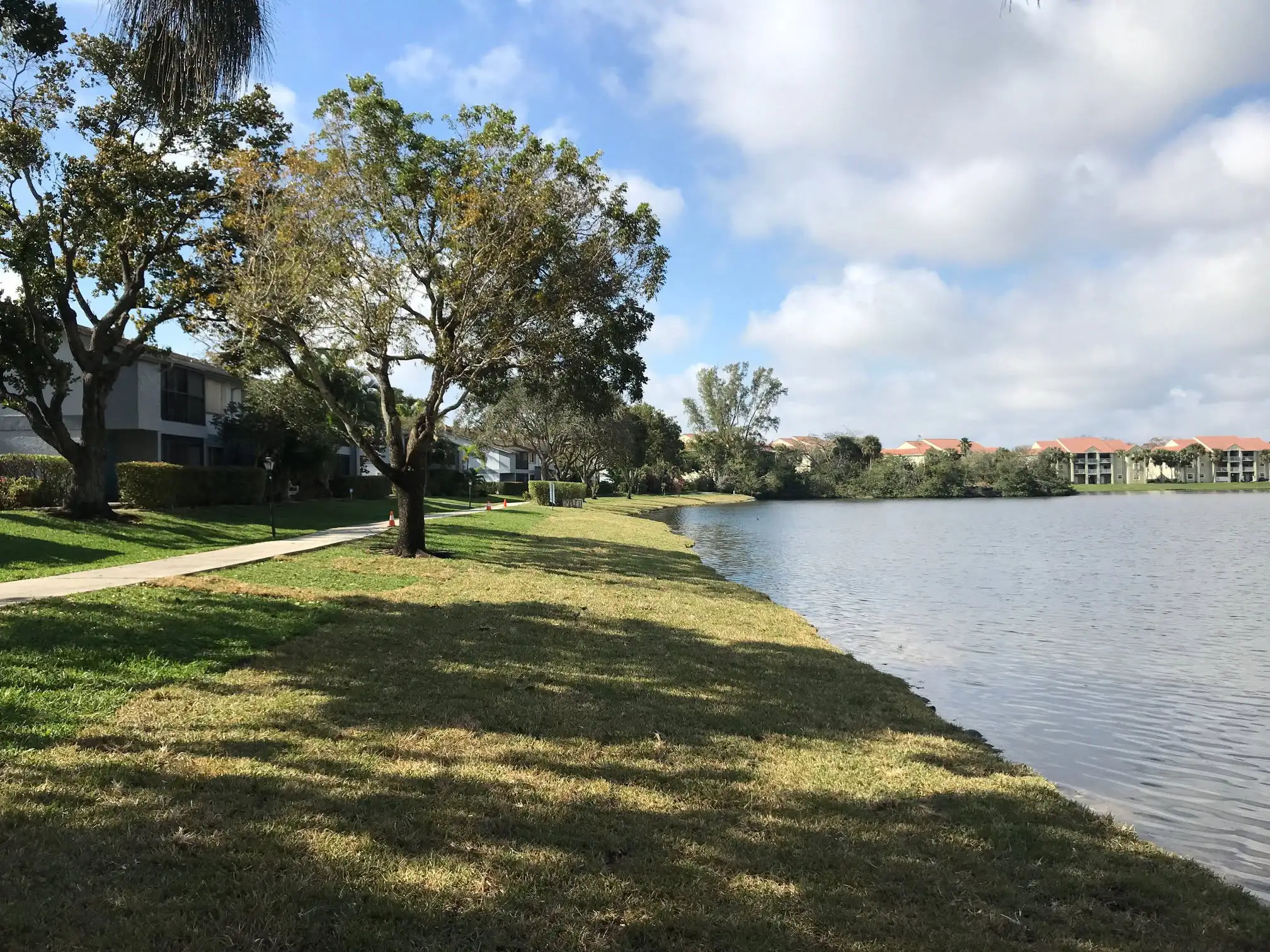
Oakland Park Lake Bank Stabilization & Shoreline Restoration
Location: Oakland Park, Broward County, Florida
Client: South Florida Community Association
Project Type: Lake Bank Stabilization & Shoreline Restoration
Project Area: More Than 15,000 Square Feet
Stabilization Systems: Flexamat Concrete Block Mat and North American Green VMax C350 Turf Reinforcement Mat
Construction Services: Excavation, Shoreline Shaping, Grading, Embankment Preparation and Stabilization
South Florida Lake Bank Stabilization Overview
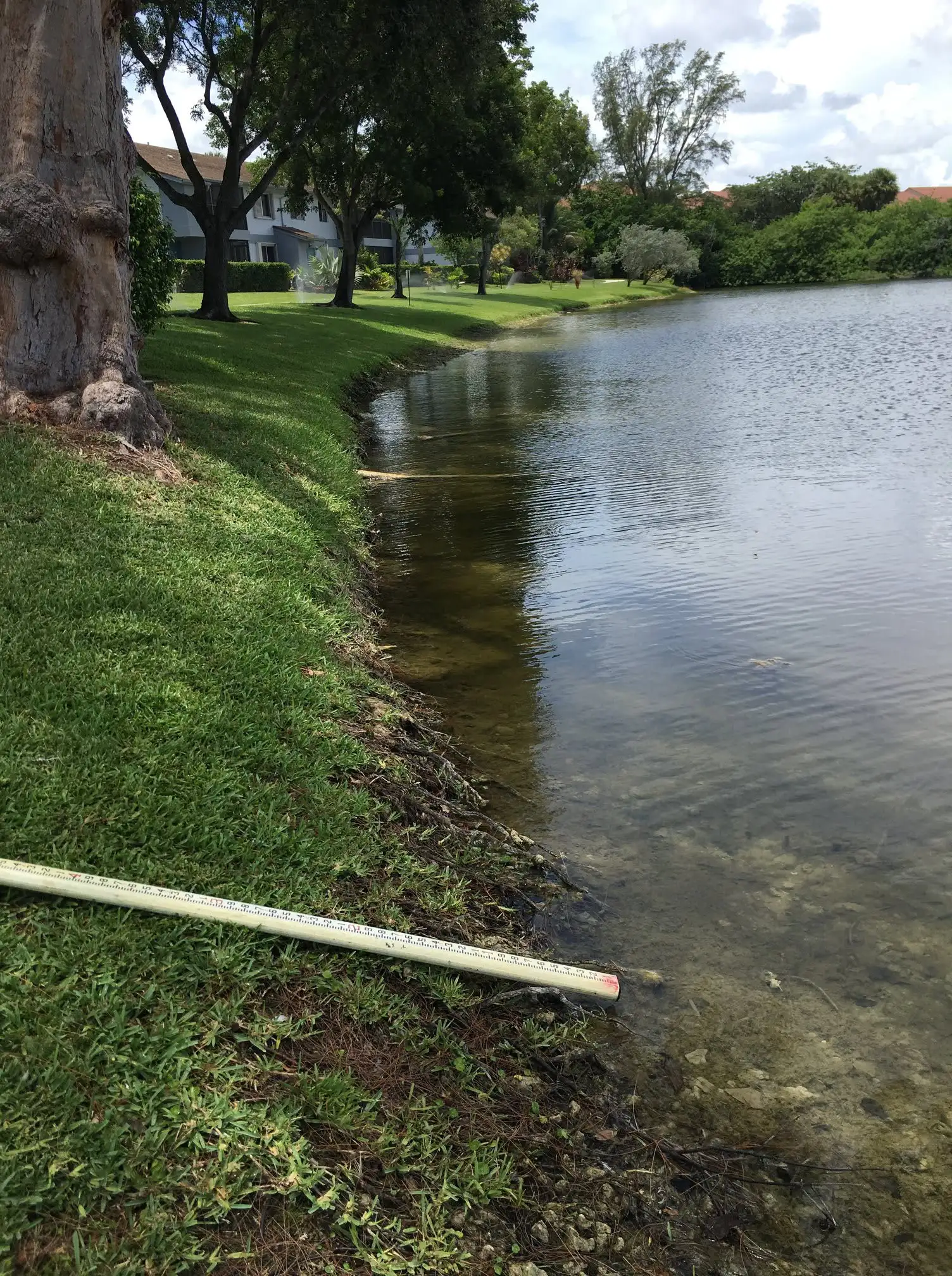
Landshore Enterprises completed a large-scale lake bank stabilization project for a residential community in Oakland Park, Florida, where ongoing shoreline erosion had significantly reduced the amount of stable, usable land surrounding the community lake.
More than 15,000 square feet of shoreline were restored using a combination of extensive embankment preparation, Flexamat concrete block mat and North American Green VMax C350 turf reinforcement mat.
The completed stabilization reclaimed approximately 10 feet of usable lake bank in affected areas while creating a more stable shoreline capable of responding to the demanding conditions found around the large South Florida lake.
Restoring an Eroding Community Lake Bank
Lake bank erosion can gradually change both the appearance and functionality of a community shoreline.
At this Oakland Park property, the large lake was exposed to wind and wave action as well as changing water levels. Over time, these forces contributed to progressive loss of soil along the shoreline and deterioration of the lake embankment.
As the bank receded, areas that had once been usable upland became unstable shoreline. Continuing erosion not only reduced the community’s usable property but also created increasingly steep and irregular bank conditions.
The objective of the restoration was therefore greater than simply covering the exposed soil.
The shoreline needed to be reconstructed into a stable profile, protected against continued erosion and capable of supporting vegetation and long-term community use.
Why Large South Florida Lakes Can Experience Significant Shoreline Erosion
Shorelines surrounding large lakes can be subjected to considerably more hydraulic stress than small, sheltered ponds.
Wind traveling across an open water surface can generate waves that repeatedly strike the shoreline. Even relatively small waves can remove soil over time when they continually impact an unprotected bank.
Fluctuating lake levels can compound the problem.
As water elevations rise and fall, different portions of the shoreline become exposed to wave action, saturation and drying. Soil near the waterline may gradually loosen and erode, allowing the upper bank to recede.
Once the original shoreline geometry begins to deteriorate, erosion can accelerate as the bank becomes steeper and less stable.
For this project, the stabilization system needed to address both the immediate loss of soil and the continuing environmental forces acting on the shoreline.
Excavation, Shaping and Lake Bank Reconstruction
Successful shoreline stabilization begins with preparation of the underlying embankment.
Landshore excavated and reshaped the deteriorated shoreline to establish the grades required for the proposed stabilization systems.
This process involved removing unstable and irregular material, reconstructing the bank profile and carefully grading the shoreline to create a uniform foundation.
The embankment then had to be prepared for installation of the concrete block mat and turf reinforcement systems.
Proper subgrade preparation was particularly important because the stabilization materials needed continuous contact with the reconstructed lake bank. Irregular grades, loose soils or unsupported areas beneath the erosion-control system could reduce its effectiveness.
Rather than installing erosion-control material over an already failing bank, the project rebuilt the shoreline first and then protected the reconstructed embankment.
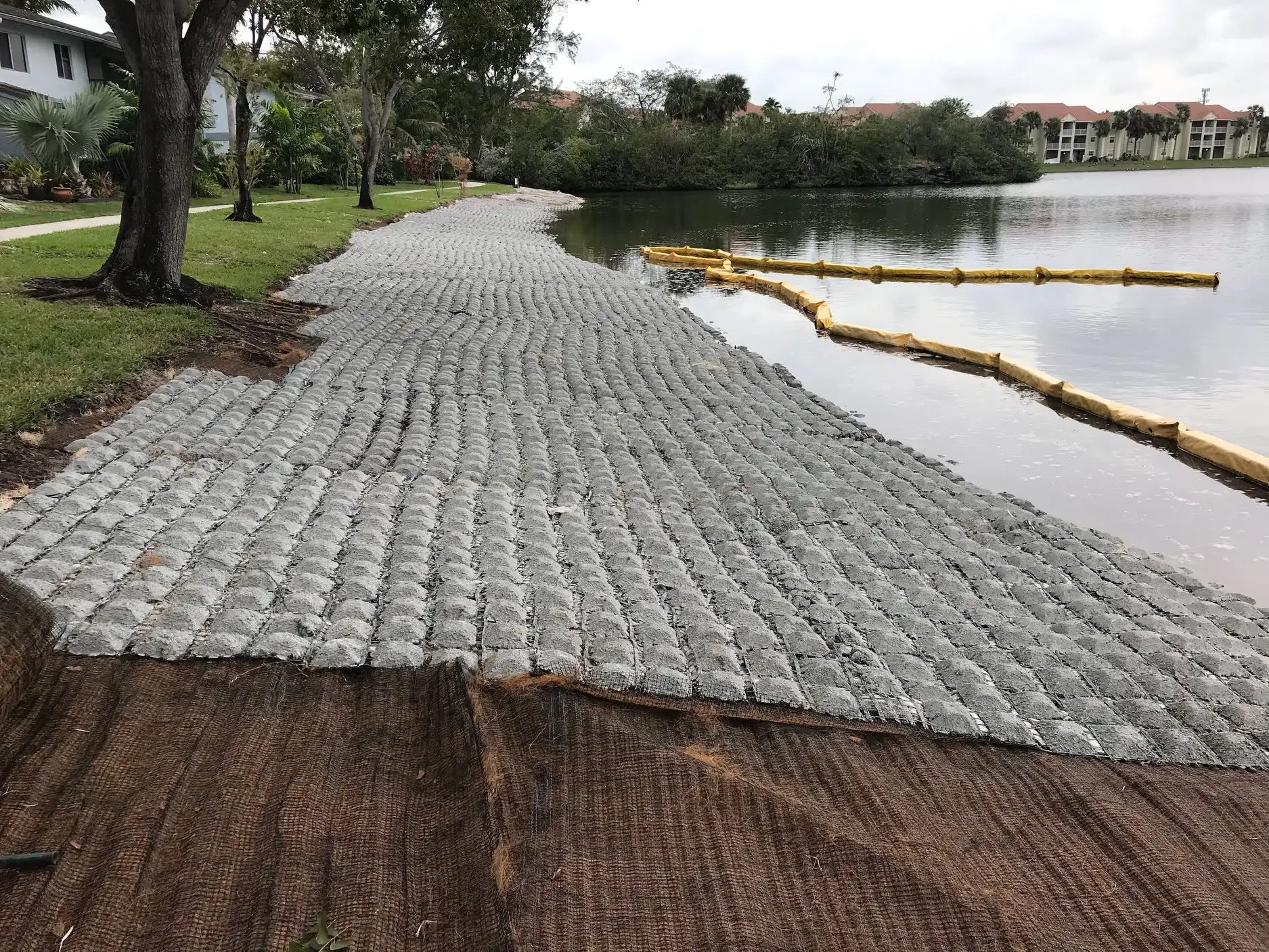
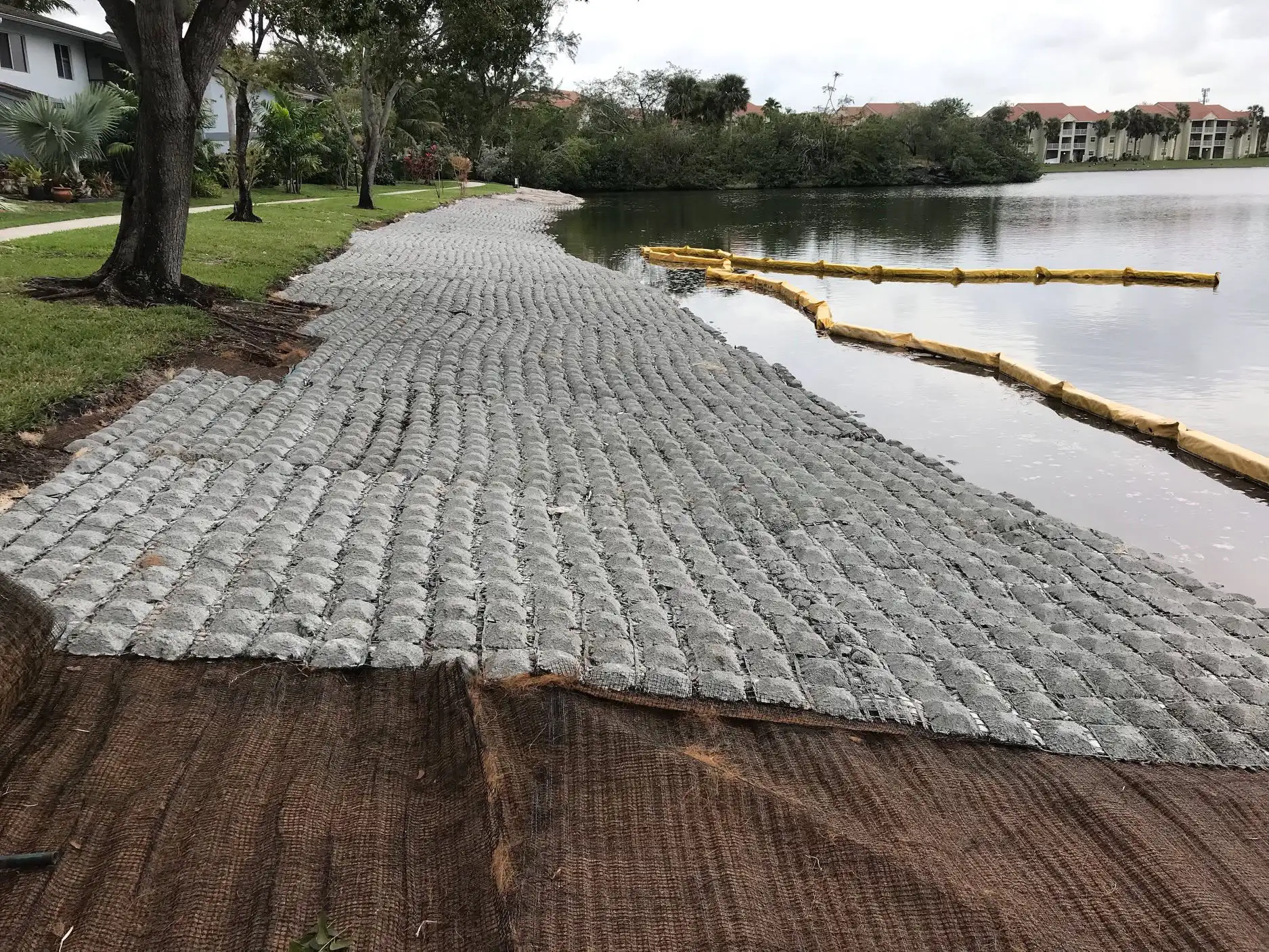
Flexamat Concrete Block Mat for Shoreline Protection
Flexamat concrete block mat was incorporated into areas of the shoreline requiring durable protection from wave action and changing lake levels.
The system combines concrete blocks into a flexible mat that can conform to the shape of a prepared embankment while providing heavier protection than vegetation alone.
For the Oakland Park lake, this allowed the reconstructed shoreline to be armored against the recurring hydraulic forces acting near the waterline while maintaining a lower-profile appearance than many traditional hard-armoring methods.
The flexibility of the system was particularly useful along the newly shaped lake bank because it allowed the erosion-control layer to follow the shoreline geometry created during grading.
Once properly installed over the prepared embankment, the concrete block mat formed a durable protective surface intended to help prevent renewed soil loss.
VMax C350 Turf Reinforcement Mat for Vegetated Slope Stabilization
North American Green VMax C350 turf reinforcement mat was also incorporated into the stabilization system.
The turf reinforcement mat provided erosion protection while allowing vegetation to become part of the finished shoreline.
This was important for the residential community because the objective was not simply to create a hardened lake edge. The restored bank needed to provide long-term stabilization while maintaining the landscaped appearance expected around a community lake.
The reinforcement mat supported vegetation while helping protect the underlying soil from erosion.
Using a vegetated reinforcement system in conjunction with the concrete block mat allowed the project to transition between areas requiring heavier hydraulic protection and areas where reinforced vegetation could provide effective slope stabilization.
Combining Structural and Vegetated Shoreline Stabilization
One of the strengths of the Oakland Park project was the use of more than one stabilization method.
The portions of the lake bank most directly affected by water, wave action and fluctuating lake levels required greater erosion resistance. Other portions of the reconstructed slope could incorporate vegetation into the stabilization system.
By combining Flexamat concrete block mat with VMax C350 turf reinforcement mat, the project created a transition from stronger shoreline armoring into reinforced vegetated slopes.
This approach provided protection appropriate to the conditions present at different elevations along the lake bank rather than relying on one material across the entire slope.
For large community lakes, this type of site-specific approach can provide an effective balance between shoreline durability, vegetation and appearance.
More Than 15,000 Square Feet of Lake Bank Stabilized
The scale of the project required extensive shoreline preparation and material installation.
More than 15,000 square feet of lake bank were excavated, shaped, graded, prepared and stabilized.
Large shoreline restoration projects require careful control of grades because relatively small variations across a long section of lake bank can affect the final slope geometry and the placement of stabilization materials.
The installation therefore depended on both the erosion-control products themselves and the earthwork performed before those products were placed.
The completed lake bank provided a reconstructed and reinforced shoreline rather than a temporary surface treatment over the existing erosion.
Reclaiming Approximately 10 Feet of Stable Shoreline
One of the most significant outcomes of the project was the recovery of land that had been lost to erosion.
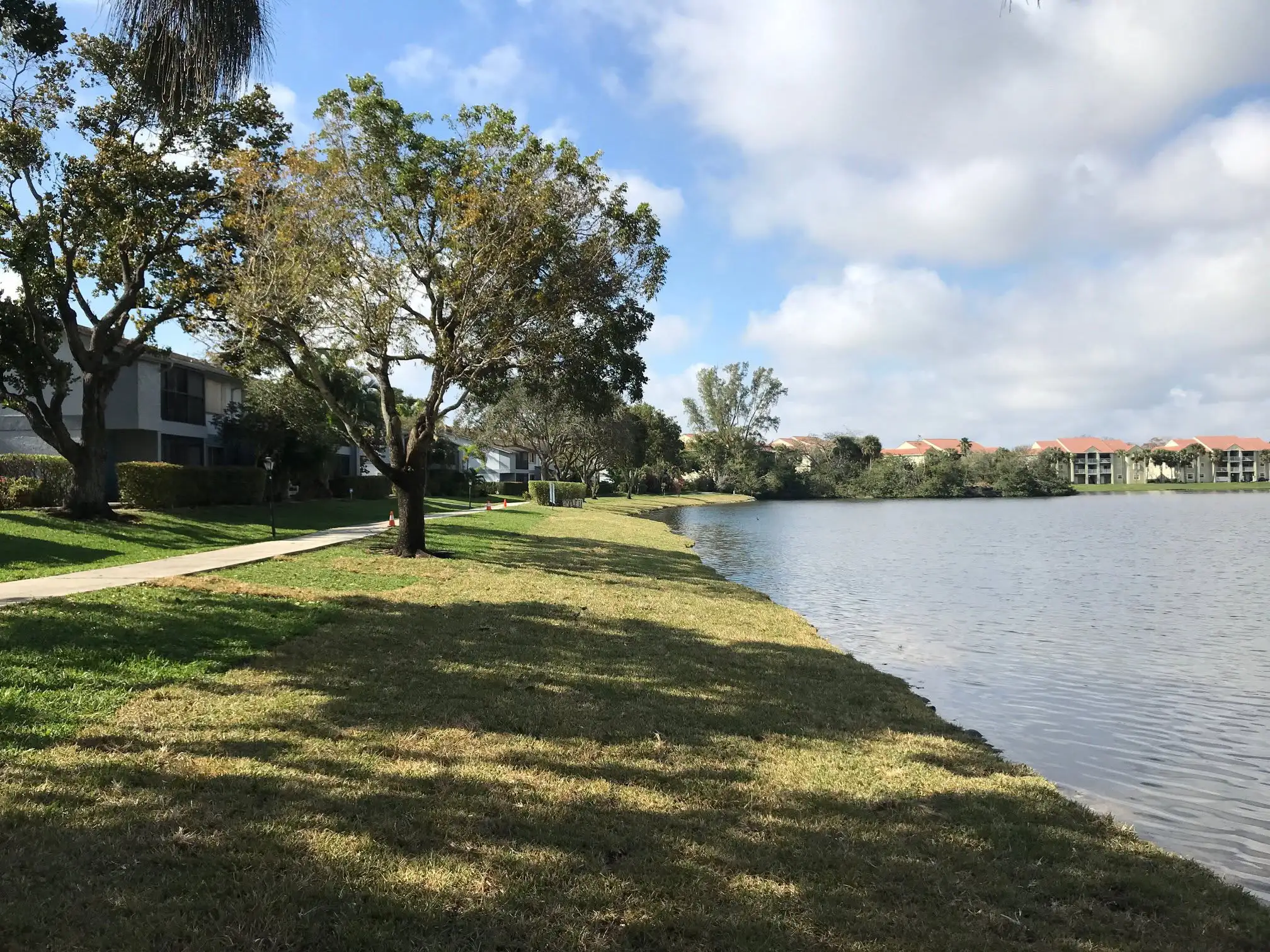
By rebuilding the deteriorated lake bank to a stable profile, the stabilization reclaimed approximately 10 feet of usable shoreline in affected areas.
This restored space between the lake and the surrounding community while replacing an irregular, retreating shoreline with a more predictable and stable embankment.
For homeowners associations and other communities, recovering eroded lake bank can be particularly important where walking areas, landscaping, buildings, drainage infrastructure or other improvements are located near the water.
The Oakland Park project demonstrates that shoreline stabilization is not limited to protecting the bank that remains. Where site conditions permit, properly planned restoration can also reconstruct portions of an embankment that have already been lost.
Addressing Wave Action and Fluctuating Water Levels
Understanding the cause of shoreline erosion is an important part of selecting an appropriate stabilization system.
At this site, the lake’s size created meaningful exposure to wind and wave action. Fluctuating water elevations also changed the portion of the bank exposed to hydraulic forces at different times.
Simply adding soil to the eroded areas without reinforcing the reconstructed slope would have left the new material vulnerable to many of the same forces that contributed to the original erosion.
The stabilization system therefore incorporated erosion-resistant materials into the reconstructed lake bank.
Flexamat provided heavier protection in areas exposed to water and wave forces, while the turf reinforcement system supported vegetation and protected the upper portions of the slope.
Together, these systems created a stabilized shoreline designed around the actual conditions affecting the lake.
Lake Bank Stabilization for South Florida Communities
Lake and pond erosion is common throughout South Florida communities.
Wind-driven waves, fluctuating water levels, stormwater runoff, sandy soils, steep slopes and inadequate shoreline protection can gradually remove soil from lake banks and retention ponds.
What begins as a small erosion area can eventually result in substantial land loss, unstable slopes and reduced separation between the water and community infrastructure.
Effective shoreline restoration begins by identifying why the bank is eroding and determining whether the existing slope can be repaired or needs to be reconstructed.
Depending on site conditions, stabilization solutions may include articulated concrete block mats, turf reinforcement mats, geocells, riprap, erosion-control panels, retaining systems, vegetated approaches or combinations of multiple systems.
The appropriate solution depends on factors including wave exposure, water-level fluctuation, slope geometry, soil conditions, available space and the intended use of the shoreline.
A Durable, Vegetated Lake Bank Restoration
The Oakland Park project transformed more than 15,000 square feet of deteriorating shoreline into a reconstructed and reinforced lake bank.
Through excavation, grading and careful embankment preparation, Landshore rebuilt the shoreline profile before installing the stabilization systems.
Flexamat concrete block mat provided durable protection against hydraulic forces near the lake, while VMax C350 turf reinforcement mat supported vegetated stabilization along other portions of the reconstructed bank.
The result was a more stable community shoreline that reclaimed approximately 10 feet of usable lake bank while addressing the wave action and changing water levels contributing to the original erosion.
Is Your Community Losing Lake Bank to Erosion?
Landshore Enterprises provides engineering and construction services for lake bank stabilization, pond shoreline restoration and erosion control throughout South Florida and across the state.
For homeowners associations, condominium communities, community development districts, golf courses and commercial properties experiencing shoreline erosion, the first step is identifying the conditions causing the bank to retreat.
Landshore can evaluate the shoreline and develop a stabilization approach based on the site’s slope, soil, water levels, hydraulic forces and long-term use requirements
Project Photos