
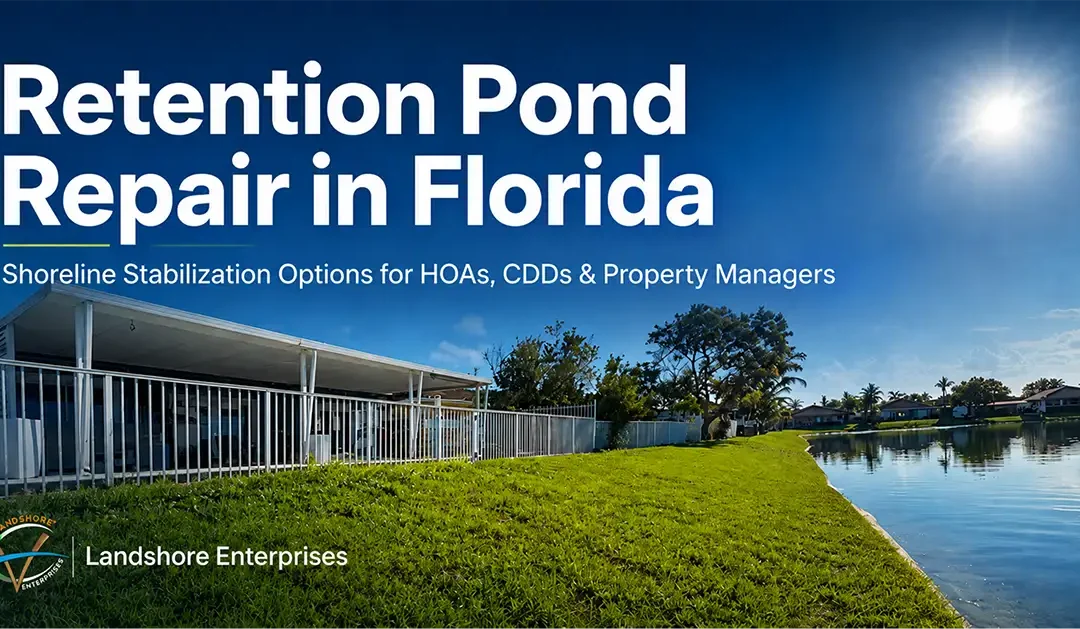
A retention pond is more than a community water feature. It is part of the property’s stormwater management system—and when its shoreline begins to fail, what appears to be a landscaping problem can quickly become an infrastructure problem.
Eroding pond banks can lead to loss of property, sediment buildup, damaged drainage structures, exposed utilities, failing sidewalks and increased maintenance costs. For homeowners associations, condominium associations, community development districts, golf courses and commercial properties, recognizing the problem early usually provides more options for repair.
The important question is not simply, “How do we cover up this erosion?”
It is:
“Why is the shoreline failing, and what type of repair will prevent it from happening again?”
What Does Retention Pond Repair Involve?
Retention pond repair can describe several types of work.
Depending on the condition of the pond, a repair project may involve:
- Shoreline stabilization
- Pond bank reconstruction
- Slope regrading
- Drainage improvements
- Repair around inlet or outfall pipes
- Sediment removal or dredging
- Replacement of failed erosion-control systems
- Vegetative restoration
- Retaining walls or sheet piling
- Stormwater structure repairs
In many cases, several of these problems occur together.
For example, concentrated stormwater runoff may wash out a section of shoreline. The eroded soil then settles in the pond, reducing water depth. Simply filling the washed-out area without correcting the drainage problem may provide only a temporary repair.
That is why successful retention pond restoration begins with identifying the cause of the failure.
Common Signs Your Retention Pond Needs Repair
Some shoreline problems are obvious. Others develop gradually.
Property managers and HOA boards should watch for:
Receding Pond Banks
If the waterline appears to be moving closer to sidewalks, fences, trees, buildings or property boundaries, soil may be gradually eroding from the shoreline.
Exposed Tree Roots
Visible roots near the shoreline are often an early indication that surrounding soil has been lost.
Undercutting at the Waterline
Wave action and changing water levels can remove soil from the bottom of the bank while the upper portion appears relatively intact.
Eventually, the unsupported soil above can slump into the pond.
Steep or Vertical Banks
A shoreline that once had a gradual slope can become increasingly steep as erosion progresses. Steep banks can also create maintenance and safety concerns.
Gullies and Washouts
Channels running down the bank often indicate that surface runoff is concentrating before entering the pond.
Repairing the shoreline without addressing that runoff can allow the erosion to return.
Exposed Drainage Pipes
Soil loss around an inlet or outfall can expose pipes and lead to additional scour around the structure.
Settled or Failing Riprap
Rock stabilization can perform well when properly designed and installed, but missing stone, settlement or soil washing through the rock may indicate that the system needs repair.
Sediment Buildup
The soil disappearing from the shoreline often ends up somewhere else—frequently at the bottom of the pond.
Over time, accumulated sediment can reduce pond depth and may eventually require dredging.
Why Do Retention Pond Banks Erode?
There is rarely one universal cause.
Florida retention ponds are exposed to a combination of forces that can gradually change their shorelines.
Common contributors include:
- Wave action
- Seasonal water-level fluctuations
- Heavy rainfall
- Concentrated stormwater runoff
- Sandy or highly erodible soils
- Poor vegetation
- Improper grading
- Failed drainage infrastructure
- Animal activity
- Aging shoreline protection
- Excessive slope angles
Understanding which of these forces are present is critical because different causes require different solutions.
A system designed primarily for wave protection, for example, may not solve a washout caused by concentrated stormwater discharge.
Retention Pond Shoreline Stabilization Options
There is no single best product for every pond.
Landshore evaluates site conditions and selects stabilization methods based on factors such as slope geometry, soil conditions, water levels, wave exposure, drainage, accessibility, environmental requirements, maintenance expectations and the intended appearance of the shoreline.
Several common approaches include the following.
- Vegetative and Bioengineered Stabilization
Some lower-energy shorelines can be stabilized using vegetation, erosion-control materials or a combination of natural and structural elements.
Vegetation can help reinforce surface soils while creating a more natural appearance.
However, vegetation alone is not appropriate for every failed shoreline. Severe drop-offs, unstable slopes, significant wave forces or poor underlying soils may require additional stabilization.
- Eco-Filter Tube Shoreline Restoration
Eco-Filter Tubes can provide a useful alternative for restoring certain lake and pond shorelines.
The tubes form a stable containment system along the bank and can be integrated into a restored slope. Depending on the project and available material, suitable sediment or fill may be incorporated into the restoration process.
One of the major aesthetic advantages is the ability to create a more natural sod-to-waterline appearance instead of constructing a vertical wall.
Eco-Filter Tubes can be particularly useful where access for large conventional construction equipment is limited or where a community prefers a less structural-looking shoreline.
- Articulated Concrete Block Mats
Articulated concrete block, or ACB, systems provide flexible armoring for areas exposed to erosion and flowing water.
They can be useful around:
- Stormwater ponds
- Drainage channels
- Outfalls
- Culverts
- Steep embankments
- Areas exposed to concentrated flow
Open-cell configurations may also allow vegetation to become part of the finished system.
- Rock Riprap
Properly designed riprap can absorb and dissipate hydraulic and wave energy.
A complete riprap installation is more than placing rocks on an eroding bank. Stone size, slope preparation, underlying filter materials and toe protection can all affect performance.
Riprap can be particularly useful around high-energy areas, drainage discharges and locations where a durable armored surface is appropriate.
- Geocellular Confinement
Geocell systems such as GeoWeb create interconnected cells that confine soil or aggregate and help stabilize slopes.
Depending on the design, geocells may support vegetation or aggregate while improving resistance to erosion.
They can be useful where a reinforced slope is preferred over a conventional vertical retaining wall.
- Turf Reinforcement Mats
High-performance Turf Reinforcement Mats can strengthen vegetated slopes and protect soil from erosive forces.
They are frequently used in drainage applications, swales, channels and slopes where vegetation is desirable but additional reinforcement is necessary.
- Retaining Walls and Sheet Piling
Some pond failures require a structural solution.
Retaining walls, bulkheads or sheet piling may be considered where space is limited, vertical retention is necessary or nearby infrastructure makes a sloped shoreline impractical.
Because these systems must resist soil and water pressures, proper design, drainage and anchoring are important.
What About Simply Adding Fill Dirt?
Placing fill along an eroding shoreline may improve its appearance temporarily, but it does not necessarily stabilize the bank.
If wave action, runoff, seepage or unstable slope geometry caused the original erosion, newly placed soil can be exposed to the same forces.
Before repeatedly adding fill, it is worth determining why the material is disappearing.
Correcting the source of the problem can reduce the cycle of repeated repairs.
When Is Engineering Recommended?
Minor maintenance does not always require an extensive engineering effort.
More significant shoreline failures, however, may benefit from engineering—particularly when the project involves:
- Significant bank retreat
- Steep or unstable slopes
- Nearby buildings or infrastructure
- Drainage structures
- Large differences in water elevation
- Dredging
- Structural retaining systems
- Complex permitting
- Multiple interconnected ponds
- Previous repairs that have failed
Engineering can help evaluate existing grades, pond geometry, drainage patterns, water levels and other site-specific conditions before selecting a stabilization system.
Does the Pond Also Need Dredging?
Shoreline erosion and sediment accumulation are closely connected.
Every cubic foot of soil lost from the shoreline has to go somewhere. Some of it remains suspended in the water, while some settles to the bottom.
A pond experiencing years of erosion may therefore have both a shoreline problem and a sediment problem.
A bathymetric survey can help determine existing pond depths and identify areas where material has accumulated.
If sediment has significantly affected the pond, shoreline restoration and dredging can sometimes be evaluated as part of the same overall project.
How Should an HOA Plan a Retention Pond Repair Project?
For communities with substantial erosion, a phased approach often works well.
Step 1: Inspect the Entire Pond
Do not evaluate only the worst-looking section.
Document the complete shoreline, drainage structures, nearby improvements and visible signs of sediment accumulation.
Step 2: Identify the Cause
Determine whether the primary problem involves waves, drainage, water-level changes, slope geometry, soil conditions or another factor.
Step 3: Prioritize Critical Areas
Areas threatening sidewalks, utilities, roads, homes or drainage infrastructure may need to be addressed first.
Step 4: Compare Appropriate Solutions
Compare systems based on more than initial construction cost.
Consider:
- Expected performance
- Service life
- Appearance
- Maintenance
- Access requirements
- Permitting
- Constructability
- Impact on residents
- Long-term cost
Step 5: Develop a Long-Term Plan
Large communities do not always need to repair every shoreline at the same time.
A documented assessment can help an HOA or CDD divide work into logical phases and budget for future repairs.
Retention Pond Repair Throughout Florida
Retention pond erosion is common throughout Florida because stormwater ponds are an important component of so many residential communities, golf courses and commercial developments.
Landshore Enterprises works with communities and property owners across Florida, including Southwest Florida and Southeast Florida, to evaluate shoreline erosion, drainage problems, sediment accumulation and stormwater infrastructure.
Our work includes shoreline restoration, erosion control, engineering, dredging, drainage improvements and construction.
The Best Time to Address Pond Erosion Is Before It Becomes an Emergency
A small section of erosion may not require an immediate major construction project.
But it should not be ignored.
Monitoring the shoreline and understanding the cause can give property managers and association boards time to compare solutions, plan budgets and complete necessary engineering or permitting before nearby infrastructure is threatened.
If your retention pond has exposed roots, steep banks, washouts, collapsing slopes or other signs of shoreline failure, Landshore Enterprises can evaluate the condition and help develop a practical long-term repair strategy.
Schedule a pond and shoreline evaluation with Landshore Enterprises.