
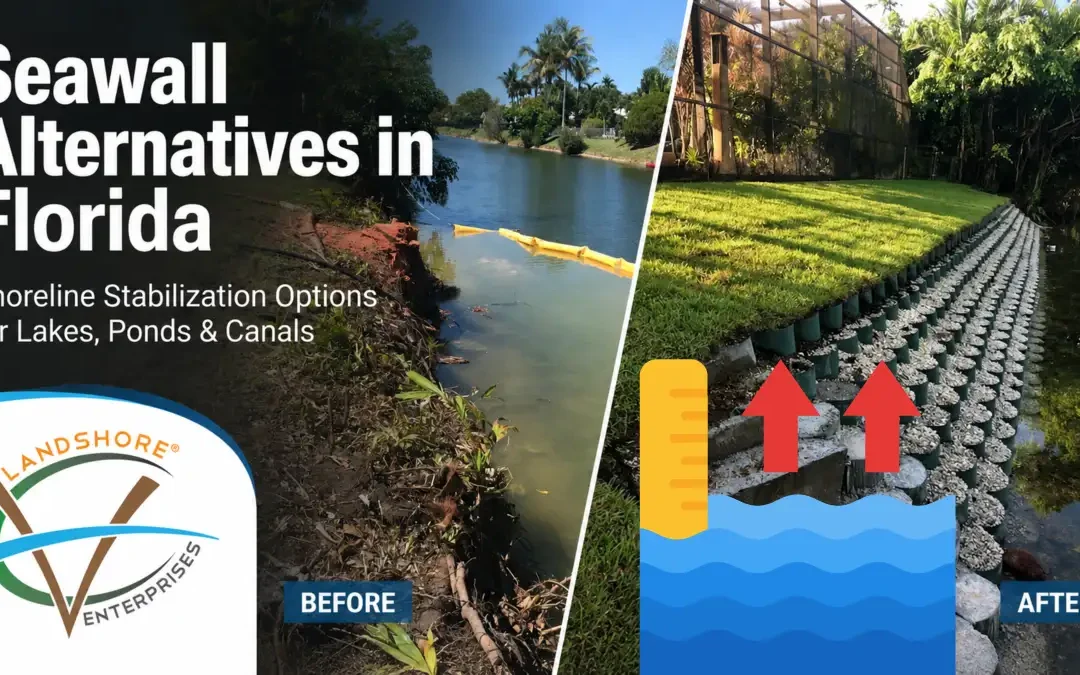
When a shoreline begins to disappear, many property owners immediately assume they need a seawall.
Sometimes they do.
But a concrete seawall or traditional sheet-pile wall is only one way to stabilize an eroding shoreline—and for lakes, retention ponds, golf course water features and some canals, a vertical wall may not be the most practical or cost-effective approach.
Florida property owners have a range of shoreline stabilization options that can provide erosion protection while creating a softer, more natural appearance.
The right choice depends on the forces causing the erosion, the available space, water conditions, soil, nearby infrastructure and how the property owner wants the finished shoreline to look.
Do You Really Need a Seawall?
The purpose of a seawall, bulkhead or sheet-pile wall is relatively straightforward: create a structural barrier between the water and the land and retain the soil behind it.
That can be extremely valuable where:
- Buildings or infrastructure are close to the water
- Space for a gradual slope is limited
- Significant vertical soil retention is required
- Boats or docks require a defined water edge
- Water depths or site geometry make other systems impractical
- Engineering determines that structural retention is necessary
But many lake and pond shorelines do not require a vertical wall.
If sufficient space exists to reconstruct and stabilize the slope, other systems may accomplish the primary objective—keeping the soil in place—without creating a traditional seawall.
Why Property Owners Look for Seawall Alternatives
There are several reasons an HOA, golf course, municipality, commercial property or waterfront owner may consider an alternative.
Appearance
A restored vegetated slope can blend into the surrounding landscape more naturally than a vertical wall.
This is particularly desirable around community lakes, golf courses and landscaped stormwater ponds.
Construction Access
Some properties have homes, fences, landscaping, cart paths or other obstacles that make heavy construction access difficult.
Certain stabilization systems can be installed with less disruption.
Environmental Goals
A sloped or vegetated shoreline can provide opportunities to incorporate native or littoral vegetation where site conditions allow.
Cost
A full structural seawall can require significant materials, engineering, anchoring, excavation and construction.
A less structural solution may be more economical where conditions allow it.
That does not mean the least expensive system should automatically be chosen. A lower-cost installation that does not address the actual cause of erosion can become expensive if it fails prematurely.
Existing Shoreline Geometry
Many ponds and lakes were originally designed with gradual side slopes.
Restoring that geometry may make more sense than converting the entire perimeter into a vertical structure.
What Causes the Shoreline to Fail?
Before comparing alternatives, it is important to determine what is actually causing the erosion.
Common causes include:
- Wave action
- Fluctuating water levels
- Concentrated stormwater runoff
- Poorly established vegetation
- Sandy or erodible soils
- Seepage
- Boat wakes
- Scour around drainage structures
- Steep slopes
- Aging stabilization systems
- Sediment loss from beneath existing armoring
Different problems require different levels of protection.
A lightly eroding community pond may need a very different solution from a deep canal exposed to boat traffic.
- Eco-Filter Tubes
Eco-Filter Tubes provide an alternative for reconstructing certain eroded pond and lake shorelines.
The geotextile tubes form a contained structure along the shoreline that can become part of the reconstructed embankment.
One of the most attractive features for communities and golf courses is the ability to create a restored slope that can transition to sod, groundcover or other appropriate vegetation near the waterline.
Depending on site conditions, suitable material from the water body may also be incorporated through hydraulic pumping, potentially reducing the amount of imported fill and providing an opportunity to remove accumulated sediment at the same time.
Eco-Filter Tubes can be particularly attractive when the goal is shoreline restoration rather than construction of a visible wall.
Best suited for: ponds, lakes, community shorelines and golf course water features where conditions allow reconstruction of a sloped bank.
- Rock Riprap
Riprap is one of the most widely recognized forms of erosion protection.
Large stone placed along the shoreline absorbs and dissipates energy from waves and flowing water.
A successful riprap installation should consider more than simply placing rock along the bank. The underlying soil, filter layer, stone gradation, slope and toe of the installation all affect performance.
Without adequate filtration, fine soil can wash through or beneath the stone and lead to settlement.
Riprap is often appropriate for:
- Canal banks
- Pond embankments
- Drainage outlets
- Creeks
- High-energy shorelines
- Scour-prone areas
- Protection around existing structures
It creates a more armored appearance than a vegetated shoreline but can provide durable protection in demanding environments.
- Articulated Concrete Block Mats
Articulated Concrete Block mats consist of interconnected concrete units that form a flexible protective layer over the soil.
Unlike a rigid concrete structure, the system can conform to the underlying slope while providing significant resistance to erosion.
ACB systems are commonly considered for:
- Stormwater ponds
- Canals and channels
- Culverts
- Drainage ditches
- Outfalls
- Embankments
- High-flow areas
Open-cell systems may allow vegetation to establish within the installation, helping soften the finished appearance.
They can be especially useful where the shoreline needs more protection than vegetation alone can provide but a full vertical wall is unnecessary.
- Geocell Shoreline Stabilization
Geocellular confinement systems such as GeoWeb use a three-dimensional network of cells to contain soil, stone or other infill.
The system helps prevent material from moving down the slope while distributing loads across the stabilized area.
Depending on the application, a geocell shoreline can support:
- Vegetated slopes
- Aggregate surfaces
- Steep embankments
- Drainage applications
- Shoreline transitions
This can provide a useful middle ground between an unreinforced vegetated slope and hard vertical armoring.
- Gabions
Gabions are wire baskets filled with stone and can be configured as retaining structures, slope protection or channel stabilization.
Because they contain rock within a defined structure, gabions can be useful in areas where loose riprap would be difficult to maintain.
They can also conform to some settlement while allowing water to drain through the structure.
Potential uses include:
- Channel banks
- Ditches
- Creek stabilization
- Retaining applications
- Scour protection
- Eroding embankments
Gabions create a more structural appearance than vegetated solutions but can provide flexibility not found in a conventional monolithic concrete wall.
- Turf Reinforcement and Vegetated Systems
Not every shoreline requires rock or concrete.
In lower-energy environments, properly designed vegetated systems can provide excellent erosion protection.
Turf Reinforcement Mats reinforce vegetation and the underlying soil, helping the combined system resist greater hydraulic forces than vegetation alone.
Bioengineered shoreline systems may also incorporate appropriate native and littoral plantings to improve root reinforcement and reduce wave energy.
These solutions work best where site conditions support healthy vegetation and the forces acting on the shoreline are within the capabilities of the system.
A vegetated approach should not be selected simply because it looks natural. It still has to be appropriate for the site’s slope, soil, water and erosion conditions.
- Hybrid Shoreline Stabilization
Some of the best shoreline designs do not rely on a single material.
A hybrid system might use:
- Riprap at a high-energy drainage discharge
- Vegetation along lower-energy shoreline areas
- ACB mats around a culvert
- Geocells on an upper slope
- Structural retaining systems only where space is restricted
This site-specific approach can avoid the unnecessary cost and appearance of armoring an entire shoreline to solve a problem that only occurs in certain locations.
For large communities, golf courses and stormwater systems, different sections of the same lake may require different solutions.
What About Sheet Piling?
Sheet piling remains an important stabilization option and should not be dismissed simply because other alternatives exist.
Modern sheet-piling systems can be constructed from materials such as vinyl, composite or recycled plastic as well as traditional materials.
Landshore has used sheet-piling systems in applications where a strong retaining structure is appropriate and where maintaining waterway width is important.
The key distinction is that sheet piling should be selected because the site requires a retaining structure—not simply because “that is what everyone uses for shoreline erosion.”
Which Shoreline Stabilization Method Is Best?
There is no universal ranking.
The best system is the one that addresses the forces acting on that particular shoreline.
Important considerations include:
Water Depth
Deep water immediately adjacent to the bank may limit some sloped restoration methods.
Available Space
If a building, roadway, pool, sidewalk or property boundary is close to the water, a structural retaining system may be necessary.
Wave and Flow Energy
Higher velocities and greater wave forces generally require more robust protection.
Soil Conditions
Loose sand, soft sediment, poorly compacted fill and seepage can significantly affect the design.
Drainage
If stormwater is washing down the bank, shoreline stabilization alone may not solve the problem. Drainage improvements may need to be incorporated into the project.
Access
The ability to reach the shoreline with equipment can affect both construction methods and project cost.
Appearance
A golf course may strongly prefer a vegetated edge, while a marina or canal property may favor a defined structural waterline.
Maintenance
Different systems have different inspection, vegetation and repair requirements.
Canal Bank Erosion Requires Special Consideration
Canals often create different conditions from community retention ponds.
Potential issues include:
- Deeper water
- Narrow waterways
- Boat wakes
- Rapid water-level changes
- Limited access
- Adjacent homes or seawalls
- Drainage discharges
- Utilities
- Property-line constraints
For these reasons, canal bank stabilization may require a more robust system than a typical pond shoreline.
Some canal projects can be stabilized using riprap, gabions, ACB systems or other methods, while others may require sheet piling or another structural retaining wall.
The decision should follow the site conditions rather than a predetermined product.
Why Engineering Matters When Comparing Seawall Alternatives
The visible erosion is only one part of the problem.
A shoreline evaluation may consider:
- Existing topography
- Bank geometry
- Water depth
- Water-level fluctuations
- Soil conditions
- Drainage
- Wave action
- Nearby infrastructure
- Existing stabilization
- Environmental constraints
- Construction access
For larger or more complex projects, measurements, bathymetric information and engineering analysis can help determine which alternatives are technically appropriate before comparing construction costs.
A Seawall Should Be One Option—Not the Starting Assumption
The goal of shoreline stabilization is not to install as much concrete, rock or sheet piling as possible.
The goal is to create a shoreline that remains stable under the forces acting on it.
Sometimes that means a seawall.
Sometimes it means rebuilding a natural-looking slope.
And sometimes the best design combines several approaches.
For Florida HOAs, CDDs, golf courses, municipalities, commercial properties and waterfront owners, evaluating the alternatives before selecting a system can lead to a shoreline that better balances performance, appearance, environmental considerations and long-term cost.
Landshore Enterprises: Engineering and Shoreline Stabilization
Landshore Enterprises specializes in evaluating and repairing erosion problems involving lakes, ponds, canals, drainage systems and other waterways.
Our capabilities include:
- Shoreline restoration
- Pond and lake bank stabilization
- Canal erosion repair
- Environmental engineering
- Drainage improvements
- Dredging and dewatering
- Eco-Filter Tubes
- Articulated Concrete Block mats
- Riprap
- GeoWeb
- Gabions
- Turf Reinforcement Mats
- Retaining walls and sheet piling
Rather than assuming one product fits every site, our objective is to evaluate the problem and identify practical solutions based on the conditions of the project.
If your shoreline is eroding and you are considering a seawall—or wondering whether another solution may be appropriate—Landshore Enterprises can help evaluate the alternatives.